
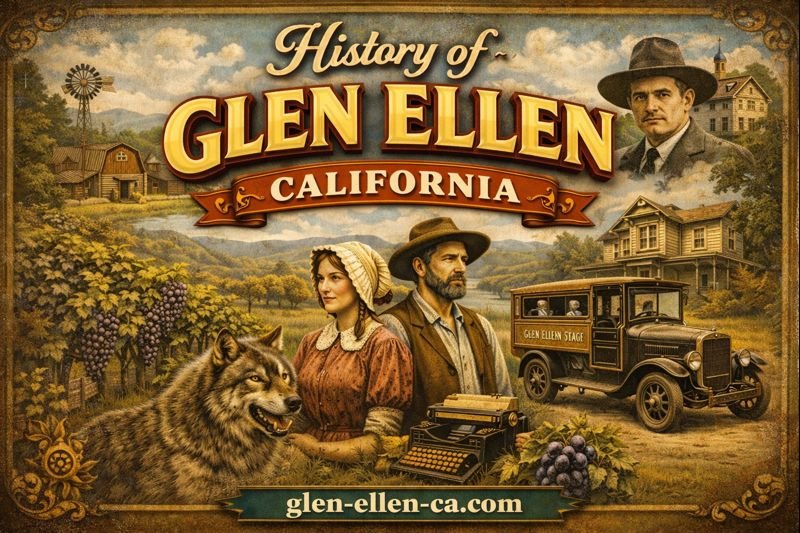
History of Glen Ellen, California
A Wine Country Village with Deep Roots in Sonoma Valley
Indigenous Peoples & Early Settlement
Long before European settlers arrived, the Sonoma Valley was home to indigenous peoples for thousands of years, including those known as the Wappo, Pomo, and Miwok tribes. The Guiluc tribe, also called the Guilucos Indians, lived in the Sonoma Valley near present-day Kenwood, as documented by Father Juan Amoros of Mission San Rafael in 1823.
In 1823, Mission San Francisco Solano de Sonoma was established—the last and northernmost of California’s missions—just two years after Mexico won independence from Spain. By 1833, Mariano Guadalupe Vallejo arrived in Sonoma to establish a military outpost, and in 1834, Governor Jose Figueroa granted him 44,000 acres of land called Rancho Petaluma.
The Birth of Glen Ellen
In 1839, General Vallejo built a sawmill at the confluence of Asbury and Sonoma Creeks, several miles north of the pueblo of Sonoma. This sawmill would become the seed of what is now Glen Ellen. By the 1850s, the nearby Calabazas Canyon had been depleted of trees, and Vallejo sold the mill to Joshua Chauvet, a French immigrant who arrived in 1856.
Charles V. Stuart, who came to California in 1849, purchased part of the Rancho Agua Caliente land grant in 1859 and named his ranch “Glen Ellen” after his wife Ellen—”glen” meaning a narrow valley. The Stuart family moved into the Glen Ellen Ranch in 1869, where Charles established a 1,000-acre vineyard, making it one of the earliest viticultural endeavors in Sonoma County.
On June 20, 1872, the “Glenelen Post Office” at “Lebanon” was officially recognized, marking the village’s official founding. Stuart later renamed his ranch Glen Oaks to avoid confusion with the growing town. Both names persist today—the town as Glen Ellen and the ranch as Glen Oaks.
Joshua Chauvet & Downtown Development
Joshua Chauvet left an indelible mark on Glen Ellen. In addition to operating the mill, he converted it to a winery and distillery in 1875, shifting to steam power. By 1880, Chauvet reported growing 120,000 pounds of grapes and producing 9,000 gallons of wine, while his mill produced over 1,000 barrels of flour.
When the San Francisco & Northwestern Pacific Railroad arrived in Glen Ellen in 1881, Chauvet championed the tourist trade, initially setting up a camp for travelers and eventually building the Chauvet Hotel in 1906. He also created a water system, established the California Brick and Pottery Company in 1903, and subdivided land to create Chauvet’s Addition to Glen Ellen.
The heart of present-day Glen Ellen centers on the Chauvet Hotel, the Chauvet Building, and the Joshua Chauvet House—all Sonoma County landmarks. Bricks produced at Chauvet’s brickyard were used in local landmarks including the Chauvet house (1905), the Chauvet Building (1905), the Hotel Chauvet (1906), and the O’Donnell Lane Bridge.
Jack London & Literary Legacy
In 1905, acclaimed author Jack London discovered Glen Ellen while horseback riding and was immediately captivated by its natural beauty. He wrote that it was “the most beautiful, primitive land to be found in California” with “great redwoods on it, some of them thousands of years old.” London purchased 128 acres for $7,000 and eventually expanded his holdings to over 1,400 acres, naming it Beauty Ranch.
London hired San Francisco architect Albert L. Farr to design his dream home—a grand 26-room mansion called Wolf House. The 15,000-square-foot structure featured a two-story living room, a library measuring 19 by 40 feet, nine fireplaces, and modern amenities including electric lighting and refrigeration. Construction began in 1911 using native Sonoma materials: unpeeled redwood logs, maroon lava boulders, and blue slate.
Tragically, on August 22, 1913, just weeks before the Londons were to move in, Wolf House burned to the ground. A 1995 forensic analysis determined that spontaneous combustion from linseed oil-soaked rags was the most likely cause. Jack London died on November 22, 1916, never having rebuilt his dream home. The property became Jack London State Historic Park in 1960, and the Wolf House ruins were designated a National Historic Landmark in 1963.
Glen Ellen’s literary legacy extends beyond London. Food writer M.F.K. Fisher and journalist Hunter S. Thompson also called Glen Ellen home at various points in their lives.
Glen Ellen Today
Today, Glen Ellen remains a charming village in Sonoma Valley’s Wine Country. Located within the Sonoma Mountain American Viticultural Area (AVA), the community is home to notable wineries including B.R. Cohn Winery, Benziger Family Winery, Mayo Family Winery, and Valley of the Moon Winery.
The village has preserved its historic character while embracing its role as a destination for wine enthusiasts, outdoor adventurers, and history buffs. Jack London State Historic Park offers hiking trails, the House of Happy Walls museum, the Wolf House ruins, and the graves of Jack and Charmian London. Nearby Quarryhill Botanic Garden houses one of the largest collections of temperate Asian plants in North America.
According to the 2020 United States Census, Glen Ellen has a population of 714 residents. The Glen Ellen Historical Society and Glen Ellen Forum continue to preserve and celebrate the village’s rich heritage, including the annual Glen Ellen Village Fair.
Need a Website That Tells Your Story?
Web Development & Digital Marketing by The Inventor’s Velocity
Contact TIV360.com Today